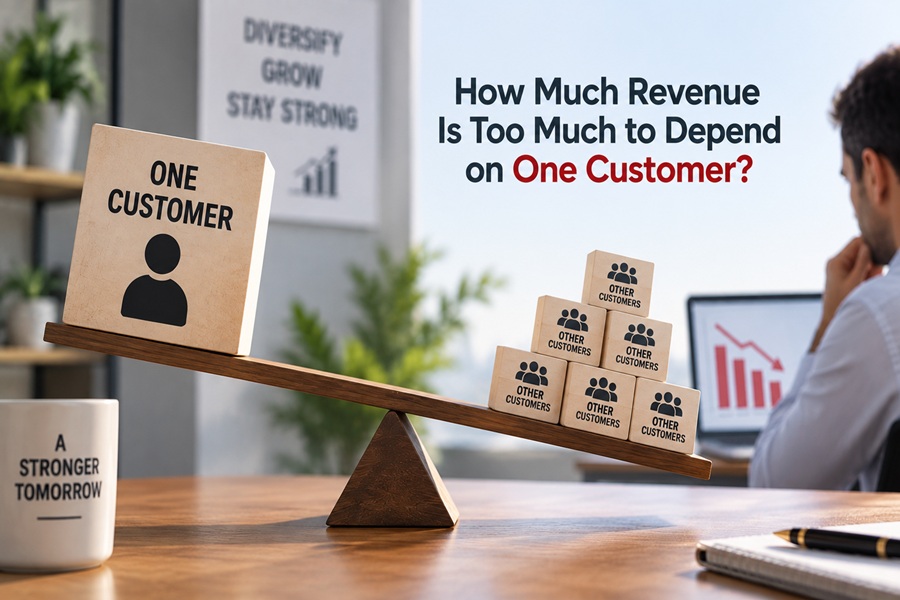
As a widely used rule of thumb, once a single customer contributes more than 10% of your total revenue, you carry meaningful concentration risk. When your top five customers together exceed 25%, the same warning applies. These are not arbitrary lines. They mark the point where losing one account stops being a bad month and starts being a threat to the business.
This is one of the most under-managed risks in small business. Revenue looks healthy right up until a key customer leaves, and then the fragility is obvious too late. Here is how to measure it, what the thresholds mean, and how to bring it down.
Quick answer: Keep any single customer below 10% of revenue and your top five combined below 25%. Risk rises sharply as a single account crosses 25%, becomes structural around 40%, and means you effectively have one customer, not a business, at 50% or more. Industry norms vary, so adjust for how fast you could replace a lost account.
What Is Customer Concentration Risk?
Customer concentration risk is the exposure you carry when too much of your revenue depends on too few customers. If one account stops buying, delays payment, or renegotiates hard, the impact ripples straight through revenue, cash flow, and stability.
You have likely heard the 80/20 rule: roughly 20% of customers drive 80% of revenue. That much is normal, especially in service businesses. The danger is different. It is when one customer grows so large that losing them would not slow the business, it would knock it sideways overnight.
What Percentage From One Customer Is Too Much?
There is no single magic number, but the thresholds below are widely cited and useful as a graduated scale.
Single customer’s share of revenue What it means Under 10% Healthy. Losing them stings but survives. 10% to 25% Caution. Real risk enters. Watch closely. 25% to 40% High risk. The business starts organizing around them. 40% to 50% Structural. The risk is built into how you operate. Over 50% You do not have a client. You have one customer who pays you a lot. The top-five test runs alongside this: keep your five largest accounts combined under 25%, and treat over 50% from your top five as a serious problem.
Do Thresholds Change by Industry?
Yes. How fast you could replace a lost customer changes what counts as dangerous.
Sector Rough concern threshold (single customer) SaaS / subscription 15% to 20% raises flags Professional services / agency 10% to 25% Manufacturing / wholesale 30% to 40% can be normal with contracts Retail (many small buyers) Concentration is usually naturally low In manufacturing and wholesale, large single accounts are common and not automatically alarming, provided you hold contracts and backup demand. In services and SaaS, the same share is riskier because relationships can end faster and with less warning.
How Do You Measure Your Concentration? Two Methods
Method 1: The simple percentage
Pull your last twelve months of revenue. List every customer from largest to smallest. Divide each one’s revenue by your total. The two numbers that matter most are your biggest customer’s share and what your top three add up to.
Method 2: The concentration score (a sharper lens)
Most guides stop at method one. Here is a more precise tool borrowed from economics: a concentration index. Square each customer’s percentage share, then add the squares together.
- Below 1,000: low concentration, a healthy spread
- 1,000 to 2,000: moderate, watch closely
- Above 2,000: high, take action
Worked example with three customers at 50%, 30%, and 20%:
50² + 30² + 20² = 2,500 + 900 + 400 = 3,800
That score of 3,800 is deep in high-risk territory, which matches the intuition that three customers carrying your whole business is fragile. The advantage of this method over a simple percentage is that it captures the shape of your whole customer base in one number, not just the top account.
Why Does Concentration Hurt Beyond the Obvious?
The revenue loss risk is clear. The subtler costs are what catch owners off guard.
- Leverage shifts to the customer. An account that knows how much of your revenue it represents can push for lower prices, longer payment terms, and extra work without extra pay. Saying no gets hard when you depend on them.
- The business bends toward them. Pricing conversations tilt their way. Product and service decisions follow their preferences. Capacity planning revolves around their forecast. You slowly reorganize around a customer you cannot afford to lose.
- Financing and valuation suffer. Banks, investors, and buyers treat concentration as a liability. Expect lower valuations and tighter loan terms.
How Do Buyers Price Concentration Risk?
If you might ever sell, this section is your wake-up call. In mergers and acquisitions, concentration becomes a direct valuation factor.
- A single customer at 10% or more gets flagged.
- Above 20%, expect a detailed diligence review and a possible reduction in your valuation multiple.
- Above 30%, many buyers decline the opportunity outright.
- The valuation discount for high concentration can range widely, often eating 20% or more of value.
The advisor’s insight here is elegant: reducing owner dependence and reducing customer concentration are the same problem viewed from two angles. Both are about whether the business can survive losing a single point of failure. Fix one and you strengthen the other.
How Do You Reduce Concentration Risk?
The cause is rarely bad luck. It is usually the absence of a deliberate plan to grow the next tier of relationships.
- Name the number. Calculate it and share it with your team. Once concentration is out in the open, hiring, pricing, and sales decisions start accounting for it.
- Feed the next tier. Deliberately grow your second and third layers of accounts so a big customer dilutes naturally over time.
- Diversify deliberately. Target new segments, not just more of the same customer type.
- Lock in with contracts. Where a large account is unavoidable, use longer contracts and notice periods to remove the sudden-loss risk.
- Watch the trend, not just the level. If your top account is 25% today but your smaller accounts grew 40% last year, the concentration is diluting on its own. Direction matters as much as the current number.
Frequently Asked Questions
What is a safe level of customer concentration?
For most small businesses, keep any single customer under 10% and your top five combined under 25%. Adjust upward only if you hold strong contracts and could replace a lost account quickly.
My biggest customer is 40% of revenue. What should I do?
Do not panic, but treat it as a priority. Protect the relationship with a solid contract, and in parallel invest aggressively in growing other accounts. The goal is to dilute the share over time, not to drop the customer abruptly.
Does concentration matter if I never plan to sell?
Yes. Even without a sale, concentration raises the risk of a sudden revenue collapse and hands pricing power to the customer. Both hurt profitability and resilience regardless of exit plans.
How is customer concentration different from customer profitability?
Profitability asks whether an account makes money. Concentration asks whether losing it would break you. A customer can be highly profitable and dangerously concentrated at the same time, which is the trickiest situation of all.
 dayonebusinessblog
Leave a comment